 Practice French
B2Full sample
Le dernier kiosque
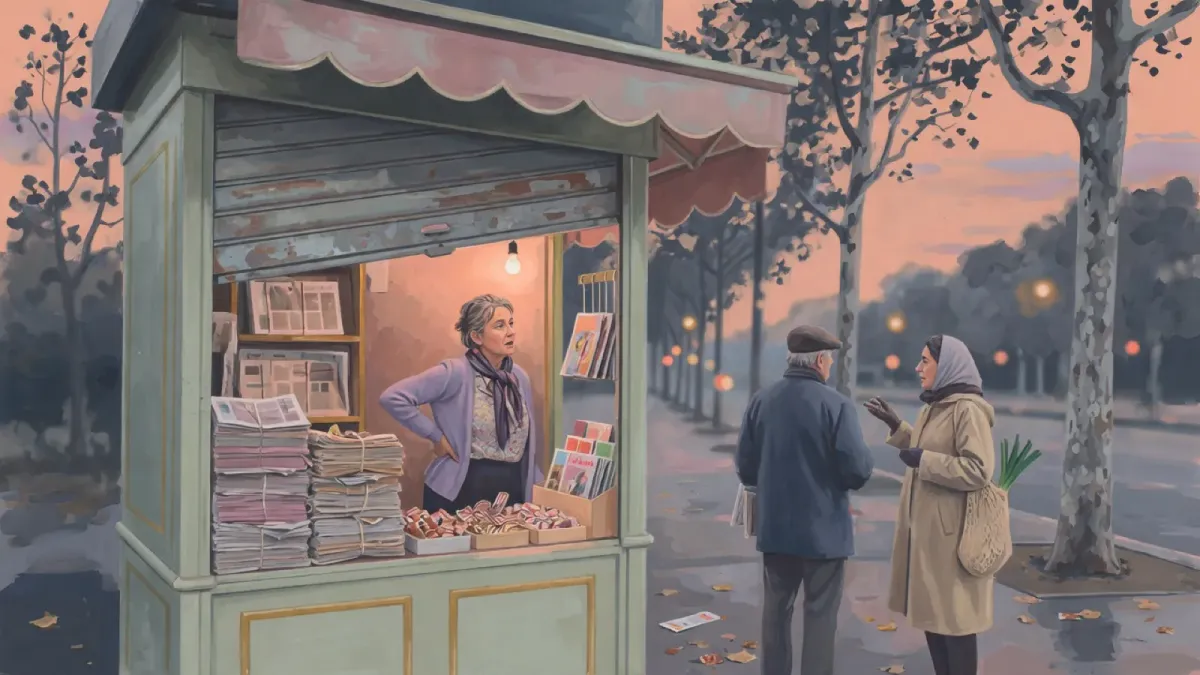
The Last Newsstand — A neighborhood newsstand closes, and the boulevard loses a place for small daily exchanges.
Écouter · listen to the opening
The complete recorded narration.
Lire · read in French
Quand le kiosque du boulevard a annoncé sa fermeture, le quartier a réagi comme on réagit à une mauvaise nouvelle trop longtemps attendue : d’abord par le déni, ensuite par les souvenirs. Hélène, la kiosquière, vendait encore des journaux, des tickets de métro et des bonbons trop sucrés, mais les chiffres, eux, n’étaient plus une opinion. Les gens prenaient leurs actualités ailleurs, plus vite, plus seuls. Un lundi, un client habituel lui a demandé pourquoi elle n’ouvrait pas un café à la place. Elle a souri sans répondre. Ce n’était pas une boutique comme une autre : on y échangeait des nouvelles du bas de l’immeuble, on y laissait un mot pour un voisin, on y apprenait qu’une rue serait fermée avant que l’affiche municipale n’apparaisse. Le dernier vendredi, Hélène a baissé le rideau plus tôt. Elle a glissé un exemplaire du journal local sous la porte de la bibliothèque, « pour la collection ». Le kiosque est devenu une façade fermée, mais le boulevard a mis du temps à retrouver son rythme. Certains passants ralentissent encore, par habitude, à l’endroit où l’on s’arrêtait pour parler.
Vocabulary
- un kiosquea newsstand
- une kiosquièrea newsstand keeper
- le dénidenial
- baisser le rideauto pull down the shutter / close for good
- une façadea facade
Show English translation
When the newsstand on the boulevard announced it was closing, the neighborhood reacted as one does to bad news that has been expected for too long: first with denial, then with memories. Hélène, the newsstand keeper, still sold papers, metro tickets and overly sweet candies, but the numbers were no longer a matter of opinion. People got their news elsewhere, faster, more alone. One Monday a regular customer asked why she didn’t open a café instead. She smiled without answering. It was not a shop like the others: people swapped downstairs news there, left a note for a neighbor, learned that a street would be closed before the municipal poster went up. On the last Friday, Hélène pulled the shutter down earlier. She slipped a copy of the local paper under the library door, “for the collection.” The newsstand became a closed facade, but the boulevard took time to find its rhythm again. Some passers-by still slow down, out of habit, at the spot where people used to stop and talk.
Comprehension questions
1. Why is the newsstand closing?
- Sales have fallen as people get news elsewhere
- Hélène wants to open a café instead
- The city is demolishing the boulevard
- The library is taking over the space
Show answer
Sales have fallen as people get news elsewhere
2. What does Hélène do with a copy of the local paper on the last Friday?
- She burns it with the other leftovers
- She slips it under the library door
- She leaves it on a café table
- She mails it to a regular customer
Show answer
She slips it under the library door
3. Hélène agrees that turning the newsstand into a café would solve the problem.
Show answer
false
4. Complete with what Hélène lowers: Le dernier vendredi, Hélène a baissé le ___ plus tôt que d’habitude.
Show answer
rideau
5. What does “le déni” mean in the opening?
- denial
- a shutter
- a souvenir
- a boulevard
Show answer
denial
Continue interactively
Open this exact story for the full narration, comprehension exercises, dictation, translation help, and saved progress.