 Practice French
C1Full sample
La carte des chemins invisibles
The Map of Invisible Paths — A young historian rediscovers the forgotten paths of a historic neighborhood, revealing their deep connection to its collective memory.
Écouter · listen to the opening
The complete recorded narration.
Lire · read in French
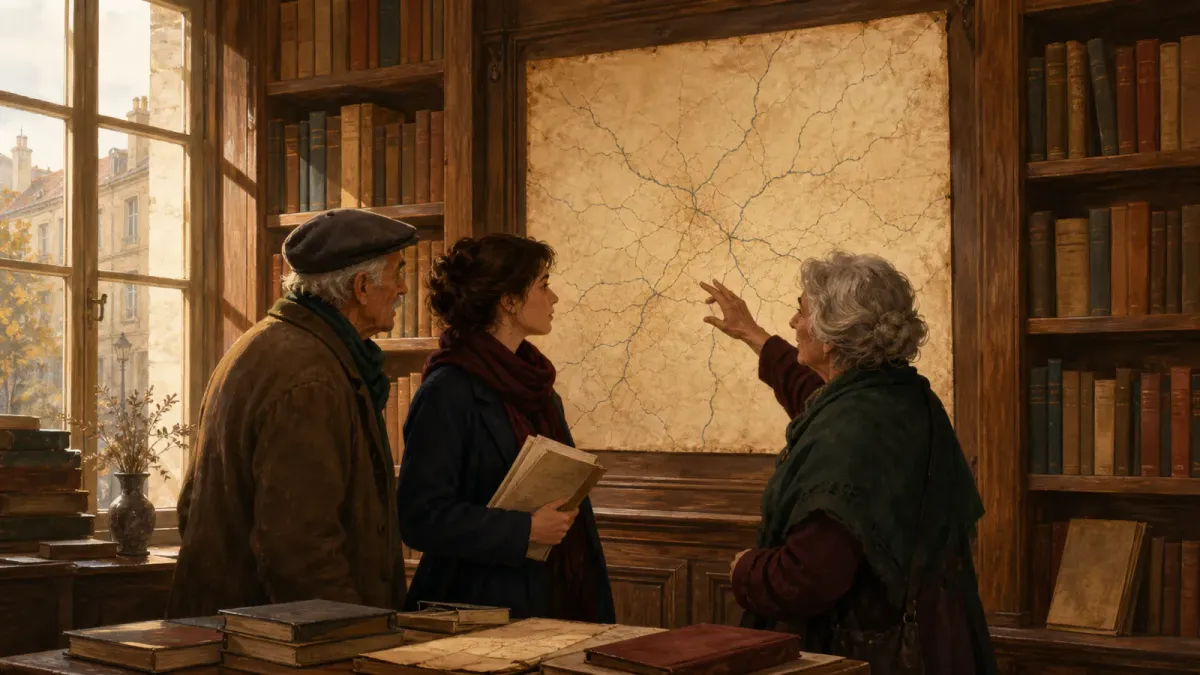
Dans le vieux quartier de Saint-Germain, une carte ancienne était accrochée au mur de la bibliothèque municipale. Elle ne montrait ni rues ni bâtiments, mais des trajets tracés à l’encre pâle, comme des cicatrices sur le parchemin. Les habitants savaient que ces lignes représentaient les chemins invisibles, ceux que leurs ancêtres avaient empruntés chaque matin pour aller au marché ou à l’église. Ces parcours, bien que disparus des plans modernes, restaient gravés dans la mémoire collective. Un jour, une jeune historienne, Claire, découvrit que ces chemins correspondaient aux itinéraires des processions religieuses du XVIIIe siècle. Elle remarqua aussi que les points de rencontre, marqués par de petites croix, coïncidaient avec les lieux où des légendes locales parlaient de miracles. Les aînés du quartier, comme Monsieur Lefèvre, se souvenaient encore des récits de leurs grands-parents décrivant ces chemins comme des veines de la ville. Pour eux, marcher sur ces traces, c’était toucher du doigt l’âme de Saint-Germain. Claire décida alors de recréer ces parcours lors d’une fête annuelle, invitant les habitants à arpenter ensemble ces routes oubliées. Ce jour-là, la ville tout entière devint un musée à ciel ouvert, où chaque pas était une page d’histoire.
Vocabulary
- parcheminparchment — Material used for old maps or documents
- gravésetched — Past participle of graver (to engrave)
- processionsprocessions
- coïncidaientcoincided — Imperfect tense of coïncider
- arpenterto walk (a path) — Often used for surveying or exploring
Show English translation
In the old Saint-Germain district, an ancient map hung on the wall of the municipal library. It showed neither streets nor buildings, but paths traced in pale ink, like scars on parchment. The locals knew that these lines represented the invisible paths, the ones their ancestors had taken every morning to go to the market or church. Though these routes had disappeared from modern maps, they remained etched in the collective memory. One day, a young historian named Claire discovered that these paths corresponded to the routes of religious processions from the 18th century. She also noticed that the meeting points, marked by small crosses, coincided with places where local legends spoke of miracles. The elders of the neighborhood, like Monsieur Lefèvre, still remembered stories from their grandparents describing these paths as the veins of the city. For them, walking these trails was like touching the soul of Saint-Germain. Claire then decided to recreate these paths during an annual festival, inviting residents to walk these forgotten routes together. That day, the entire city became an open-air museum, where every step was a page of history.
Comprehension questions
1. What do the pale ink lines on the map represent?
- Modern streets of Saint-Germain
- Rivers and canals
- Invisible paths used by ancestors
- Boundaries of old properties
Show answer
Invisible paths used by ancestors
2. What did Claire discover about the paths on the map?
- They were fictional stories
- They were modern walking trails
- They matched 18th-century religious procession routes
- They were used only by children
Show answer
They matched 18th-century religious procession routes
3. The meeting points marked with crosses were unrelated to local legends.
Show answer
false
4. What does 'parchemin' mean in the context of the passage?
- Paper
- Parchment
- Stone
- Metal
Show answer
Parchment
5. Les habitants savaient que ces lignes représentaient les chemins ___.
Show answer
invisibles
Continue interactively
Open this exact story for the full narration, comprehension exercises, dictation, translation help, and saved progress.