 Practice French
C1Full sample
La ville qui ralentit
The City That Slows Down — A transformed road gives the city new calm, but also raises questions about fairness and desirability.
Écouter · listen to the opening
The complete recorded narration.
Lire · read in French
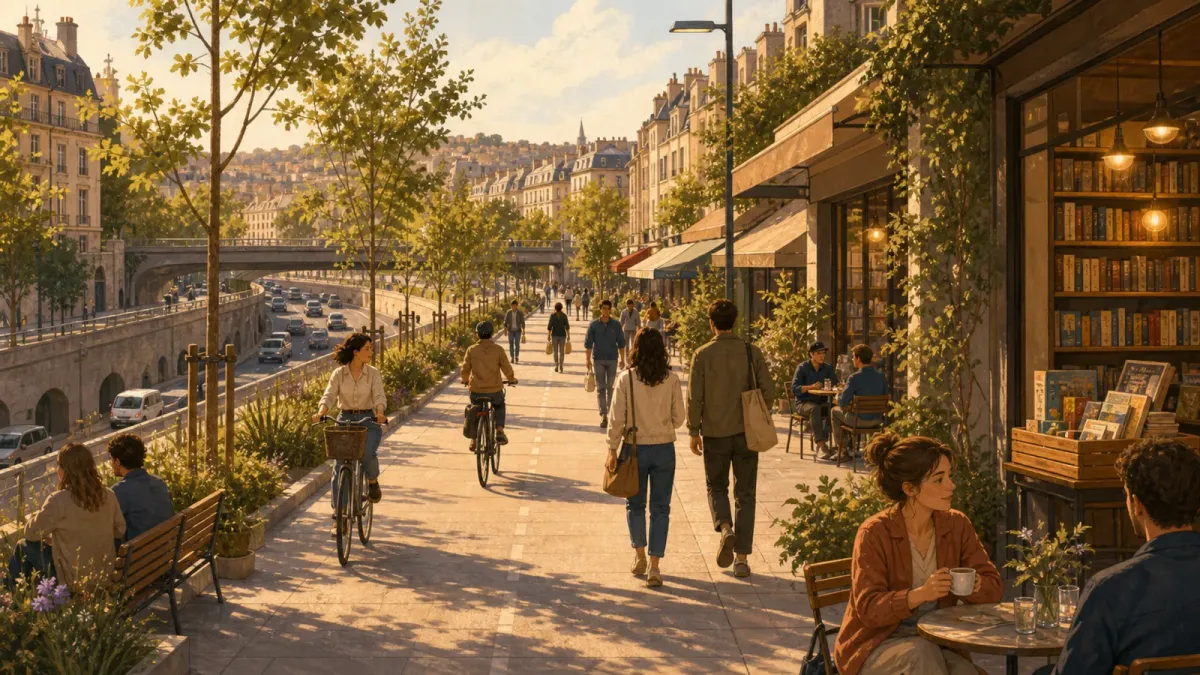
Depuis que l’ancienne voie rapide est devenue une promenade, la ville semble respirer autrement. Les automobilistes parlent encore de détour, de perte de temps, de commerce menacé. Les habitants du quartier, eux, découvrent des bancs, des arbres jeunes, des enfants qui traversent sans courir. Rien n’est spectaculaire. Les cafés n’ont pas soudain doublé leur clientèle, et les loyers, déjà trop hauts, n’ont pas attendu les fleurs pour monter. Pourtant quelque chose s’est déplacé. Là où le bruit imposait une urgence permanente, les conversations peuvent désormais s’attarder. Une libraire m’a confié qu’elle vendait moins de journaux du matin, mais plus de carnets. Ce détail me paraît moins anecdotique qu’il n’en a l’air. Une ville qui ralentit ne devient pas forcément plus juste; elle offre seulement la possibilité de remarquer ce qui était couvert par la vitesse. Le vrai test viendra plus tard, lorsque les usages ordinaires auront remplacé l’inauguration et ses discours prudents. Reste à savoir si cette attention nouvelle servira à partager l’espace ou seulement à le rendre plus désirable.
Key vocabulary
- une voie rapidean expressway
- un détoura detour
- s’attarderto linger
- anecdotiqueanecdotal / incidental
- les usages ordinaireseveryday uses
Show English translation
Since the old expressway became a promenade, the city seems to breathe differently. Drivers still speak of detours, lost time, and threatened shops. The neighborhood residents, meanwhile, discover benches, young trees, and children crossing without running. Nothing is spectacular. The cafés have not suddenly doubled their customers, and rents, already too high, did not wait for flowers before rising. Yet something has shifted. Where noise imposed a permanent urgency, conversations can now linger. A bookseller told me she sold fewer morning newspapers but more notebooks. That detail seems less anecdotal to me than it appears. A city that slows down does not necessarily become fairer; it merely offers the possibility of noticing what speed used to cover. The real test will come later, when ordinary uses have replaced the inauguration and its cautious speeches. The question remains whether this new attention will help share space or simply make it more desirable.
Comprehension questions
1. What is the text mainly questioning?
- Whether traffic will disappear completely
- Whether calmer urban space will be shared fairly
- Whether cafés should close earlier
- Whether bookstores sell enough newspapers
Show answer
Whether calmer urban space will be shared fairly
2. What does the bookseller sell more of?
- Flowers
- Notebooks
- Morning newspapers
- Bicycle maps
Show answer
Notebooks
3. Complete the sentence: Une ville qui ralentit ne devient pas forcément plus ___.
Show answer
juste
4. Why does the narrator mention the shift from newspapers to notebooks?
- It establishes that the promenade caused rents to rise.
- It suggests a change in how people use their time, without proving social justice.
- It proves that all local shops are now more profitable.
- It shows that residents no longer care about public affairs.
Show answer
It suggests a change in how people use their time, without proving social justice.
5. What unresolved tension shapes the final sentence?
- A more attractive space may become either more shared or more exclusive.
- Residents must choose between trees and all commercial activity.
- The city must restore the road to achieve fairness.
- The inauguration has already settled who will benefit.
Show answer
A more attractive space may become either more shared or more exclusive.
Continue interactively
Open this exact story for the full narration, comprehension exercises, dictation, translation help, and saved progress.